KitchenAid Stand Mixer Review 2026: Is It Still a Must-Have Kitchen Appliance?
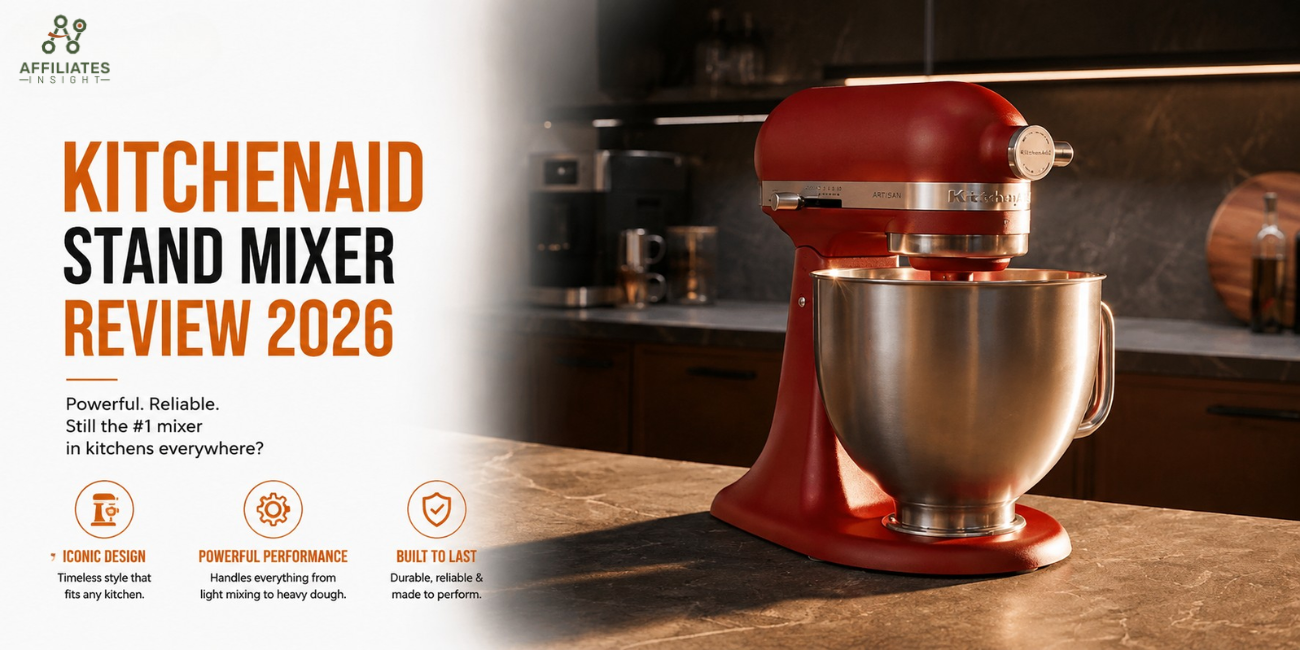
The KitchenAid stand mixer has built a reputation that few kitchen appliances can match. It’s been around for decades and still shows up in home kitchens, bakeries, and cooking shows as a go-to tool for baking and food prep. But in 2026, with cheaper and more powerful alternatives available, the question is whether it still deserves its premium status.
Table of Contents
- Product Overview
- Key Specifications
- Design & Build Quality
- Performance & Mixing Power
- Attachments & Versatility
- Ease of Use
- Pros and Cons
- Comparison With Alternatives
- Pricing & Value
- Final Verdict
- FAQs
1. Product Overview
The KitchenAid Artisan Stand Mixer is designed mainly for home cooking and baking. It handles everyday kitchen tasks like mixing cake batter, whipping cream, and preparing dough. Over time, it has become more of a long-term kitchen investment rather than a basic appliance purchase.
2. Key Specifications
Most KitchenAid stand mixers come with a 4.5 to 5-quart stainless steel bowl and multiple speed settings, usually up to ten levels. The design is either tilt-head or bowl-lift depending on the model, and the body is made mostly of metal for durability. It also supports a wide range of attachments that expand its use beyond baking. The focus here is not extreme power, but steady and consistent performance for everyday kitchen tasks.
3. Design & Build Quality
One of the strongest selling points of the KitchenAid mixer is its build quality. It has a solid metal body that feels heavy and stable on the counter, which actually helps during mixing. The design is simple and timeless, and it comes in a wide range of colors that fit different kitchen styles. The weight might feel like a downside at first, but it contributes to stability when handling thick mixtures.
4. Performance & Mixing Power
In real-world use, the KitchenAid mixer performs reliably for most home baking needs. It handles cake batters, cream, and medium dough with ease, and the mixing is consistent across different speeds. However, it is not designed for extremely heavy or large batches of dough. In those cases, more commercial-style mixers perform better. For everyday baking, though, it remains more than capable.
5. Attachments & Versatility
What really sets KitchenAid apart is its attachment system. With the right add-ons, the mixer can go beyond baking and handle tasks like making pasta, grinding meat, or even preparing ice cream. This flexibility means one machine can replace several kitchen appliances, which is one of the reasons it stays popular even today.
6. Ease of Use
The KitchenAid mixer is very beginner-friendly. The controls are simple, the speed adjustment is straightforward, and switching attachments is quick once you get used to it. Cleaning is also manageable since most parts are easy to remove and wash. Even for first-time users, there is very little learning curve.
7. Pros and Cons
The biggest advantage of the KitchenAid stand mixer is its durability and long-term reliability. It feels solid, performs consistently, and supports a wide range of attachments that make it more versatile than most competitors. On the downside, it comes with a high price tag, takes up counter space, and is quite heavy. It also struggles with very large or heavy dough batches, and attachments can become expensive if you expand its use.
8. Comparison With Alternatives
Compared to budget mixers, KitchenAid is significantly more durable and stable, but also more expensive. High-end commercial mixers may offer more power, but they are usually bulkier and less practical for home kitchens. KitchenAid sits in the middle, offering a balance of design, usability, and long-term reliability rather than raw performance or low cost.
9. Pricing & Value
KitchenAid mixers are definitely a premium purchase. At full price, they may feel expensive for casual users. However, they often go on sale, and their long lifespan changes the value equation. Many users keep the same mixer for over a decade, which spreads the cost over time and makes it more reasonable as a long-term investment rather than a short-term gadget.
10. Final Verdict
The KitchenAid stand mixer is still one of the most reliable and well-rounded kitchen appliances in 2026, but it is not for everyone. It makes the most sense for people who bake regularly, enjoy cooking at home, and want a durable appliance that lasts for years. It is less suitable for occasional bakers or those with limited kitchen space. In simple terms, it is not just a mixer you buy it is one you commit to using for the long term.
11. FAQs
Is the KitchenAid stand mixer worth it in 2026?
Yes, especially for regular home bakers who want durability and consistency.
Which model is best for beginners?
The Artisan series is the most commonly recommended starting point.
Can it handle bread dough?
Yes, but very heavy or large batches may be challenging.
Are attachments worth it?
Yes, if you plan to use them regularly, they significantly increase versatility.
How long does it last?
With proper care, it can easily last 10 years or more.